Stay home with help, or move? The honest math for Washington
Below about 30-40 hours of weekly help, home usually wins on cost; past that - or when safety needs someone always present - the community math takes over.
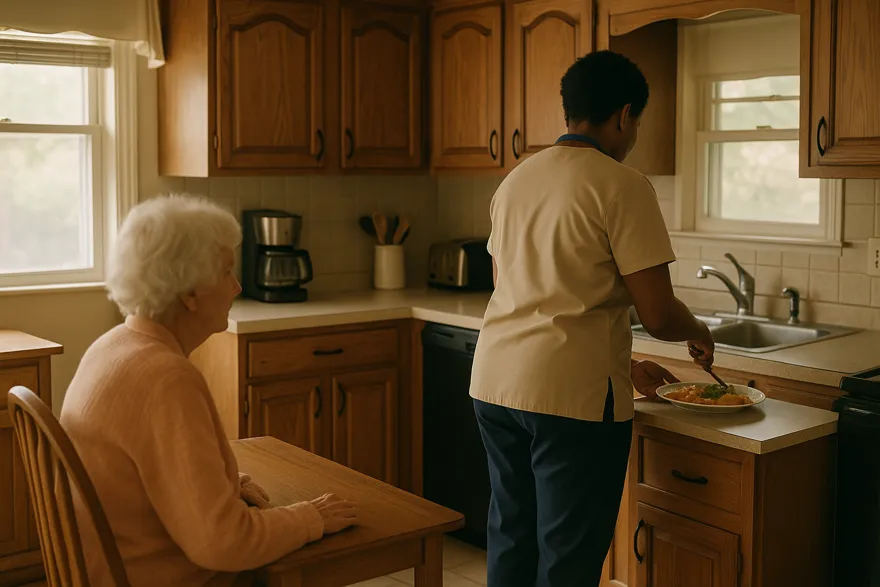
In-home care averages $35 an hour nationally - about $80,080 a year at 44 hours a week for Washington households.
Assisted living near Washington compares against a national median of $6,200 a month (District of Columbia figures shown where published in the 2025 survey).
Washington, District of Columbia has about 702,250 residents, and its care prices track the metro market and the state's rules - both covered on this page.
The home-versus-community math is mostly hours: in-home care at $35 an hour serves people who need help, not supervision. Past roughly 40 hours a week - or any point where safety needs someone present around the clock - assisted living at $6,200 a month usually costs less than equivalent home coverage.
Home care keeps your parent in familiar surroundings and costs less at low hours; communities win on 24/7 coverage, social contact and predictable pricing. The wrong choice is usually the one made in a crisis - which is why running these numbers early matters more than getting them perfect.

The 2026 numbers
| Care type | 2025 national median | What it covers |
|---|---|---|
| In-home care | $35/hour | Non-medical help at home - meals, bathing, companionship |
| Adult day care | $95/day | Daytime supervision and activities, evenings at home |
| Assisted living | $6,200/month | Housing plus daily-living help; care-level fees extra |
| Memory care | typically 20-40% above assisted living | Secured dementia care with higher staffing |
| Nursing home (semi-private) | $9,581/month | 24/7 skilled medical care |
| Nursing home (private room) | $355/day | Same care, private room |
Find senior care options near Washington
These platforms show communities and home-care agencies near you with pricing guidance. Advisors are free to families - providers pay them, as they do this site.
Disclosure: this is an independent guide. If you connect with a provider through a link here, the platform may pay this site a referral fee. That fee never changes your price - and it never changes what the inspection records say.
What this means for Washington families
Home care keeps your parent in familiar surroundings and costs less at low hours; communities win on 24/7 coverage, social contact and predictable pricing. The wrong choice is usually the one made in a crisis - which is why running these numbers early matters more than getting them perfect.
This guide is research, not advice: an independent summary of published costs and state rules. It is not a care provider, placement agency, law firm or financial advisor - care and Medicaid decisions deserve professional advice for your family's situation.
Common questions
When should we start looking?
Before the crisis. Good communities near you have waitlists, and emergency placements take whatever bed is open at premium rates. Touring while your parent is stable costs nothing, builds the shortlist, and turns a future emergency into a phone call.
How do I check a facility's inspection record?
Every state has a licensing or certification agency that publishes inspection results and complaint histories - this guide links your state's agency on every page. Search every finalist before any deposit: violations, complaint patterns and how the operator responded tell you more than the tour.
Can a facility evict my parent?
Yes - discharge policies allow it for reasons like funds running out, care needs exceeding what the license covers, or behavior issues. Read the discharge clause before signing and get the funds-run-out answer in writing; involuntary moves are the outcome families regret most.
Does Medicaid pay for assisted living?
It depends entirely on your state: 36 states cover some assisted living services through waivers, 9 cover them in limited settings, and 6 have no assisted living pathway at all. Even where covered, waivers typically pay for care services while the family handles room and board. This guide's Medicaid page gives your state's verified answer.
What is the difference between assisted living and a nursing home?
Assisted living provides housing plus help with daily activities - meals, medication, bathing - at a median $6,200 a month. Nursing homes provide 24/7 skilled medical care at a median $9,581 a month for a semi-private room. The dividing line is medical need: wound care, feeding tubes and ventilators are nursing-home territory.
Find senior care options near Washington
These platforms show communities and home-care agencies near you with pricing guidance. Advisors are free to families - providers pay them, as they do this site.
Disclosure: this is an independent guide. If you connect with a provider through a link here, the platform may pay this site a referral fee. That fee never changes your price - and it never changes what the inspection records say.