What senior care costs near Twin Lakes - and how to choose without regret
Long-term care pricing is opaque by design - communities quote by tour, not by menu. This guide anchors Twin Lakes families with published medians, Wisconsin's rules, and the questions that make quotes comparable.
Assisted living near Twin Lakes compares against a national median of $6,200 a month - and Wisconsin's own median of $6,540, ranked #19 of 50 states.
In-home care averages $35 an hour nationally - about $80,080 a year at 44 hours a week for Twin Lakes households.
A semi-private nursing home room runs $9,581 a month at the 2025 national median - the number Twin Lakes families weighing skilled care start from.
Twin Lakes plus 12 surrounding towns within 40 km share one senior-care market of about 90,210 people - comparing 3-4 communities is realistic.
Waitlists are the hidden cost near Twin Lakes: good communities fill up, and crisis placements pay premium rates for whatever is open. Starting the search before the emergency is the single biggest money-saver in long-term care.
Twin Lakes has about 6,328 residents, and its families face the same three care paths as everywhere else: in-home help (around $35 an hour nationally), assisted living (median $6,200 a month), and nursing care ($9,581 for a semi-private room). What changes locally is availability, waitlists and Wisconsin's rules - covered below.
What care costs in 2026
| Care type | 2025 national median | What it covers |
|---|---|---|
| In-home care | $35/hour | Non-medical help at home - meals, bathing, companionship |
| Adult day care | $95/day | Daytime supervision and activities, evenings at home |
| Assisted living | $6,200/month | Housing plus daily-living help; care-level fees extra |
| Memory care | typically 20-40% above assisted living | Secured dementia care with higher staffing |
| Nursing home (semi-private) | $9,581/month | 24/7 skilled medical care |
| Nursing home (private room) | $355/day | Same care, private room |
Compare senior care options near Twin Lakes
These platforms show communities and home-care agencies near you with pricing guidance. Advisors are free to families - providers pay them, as they do this site.
Disclosure: this is an independent guide. If you connect with a provider through a link here, the platform may pay this site a referral fee. That fee never changes your price - and it never changes what the inspection records say.
Wisconsin: Medicaid, prices and the inspection file
| Question | Wisconsin answer |
|---|---|
| Medicaid & assisted living | Yes - Wisconsin's two Medicaid long-term care programs, Family Care (through a managed care organization) and IRIS (self-directed), pay for assisted living SERVICES but not room and board, which "are the responsibility of the program members who must pay these costs out of pocket"; Family Care members may live in a licensed CBRF, a licensed or certified adult family home, or a certified RCAC, while IRIS members may only use their own home, a licensed/certified AFH or a certified RCAC (CBRFs and registered RCACs are not allowable IRIS settings). |
| State median, assisted living | $6,540/month (#19 of 50 states) |
| Licensing & inspection records | Wisconsin Department of Health Services (DHS), Division of Quality Assurance (DQA) |
Wisconsin has no license category called "assisted living facility" - DQA licenses Community-Based Residential Facilities (CBRFs, 5+ residents, up to 3 hours of nursing care per week) and 3-4 bed Adult Family Homes, certifies 1-2 bed Adult Family Homes, and registers or certifies Residential Care Apartment Complexes (RCACs, independent apartments, max 28 hours/week of services); crucially, a merely REGISTERED RCAC may serve private-pay tenants only, so Medicaid dollars cannot follow a resident there - only a CERTIFIED RCAC can take Medicaid waiver funding.
This guide is research, not advice: an independent summary of published costs and state rules. It is not a care provider, placement agency, law firm or financial advisor - care and Medicaid decisions deserve professional advice for your family's situation.
Why only these platforms
Ask anyone who moved a parent twice: the expensive mistake was not the rent, it was choosing on price and lobby furniture. Staffing ratios, inspection history and what-happens-when-money-runs-out answers are the real price tags - and they are free to check.
Senior care referral is an industry with real abuse - phone-blast lead sellers and pay-to-play rankings. This guide only links platforms that show you multiple named communities and let you decline: never single-facility funnels. And no platform placement replaces the one check that matters - your state's own inspection records, linked on every page of this guide.
| Platform | What you get | Background |
|---|---|---|
| A Place for Mom | Free advisor + shortlist of communities near you | Largest U.S. senior living referral network |
| Caring.com | Directory with reviews and pricing guidance | Established senior care directory |
Starting the search around Twin Lakes
Timing matters: communities negotiate more at month-end and when occupancy dips. Waived community fees and first-month discounts are common asks that families simply do not know to make.
- Your parent's care needs honestly assessed - hours of help, mobility, memory
- Last 12 months of their finances - what monthly number is sustainable
- The all-in monthly quote at their assessed care level, not the base rent
- Wisconsin's inspection record for every finalist (agency linked on this page)
- The what-happens-when-savings-run-out answer, in writing
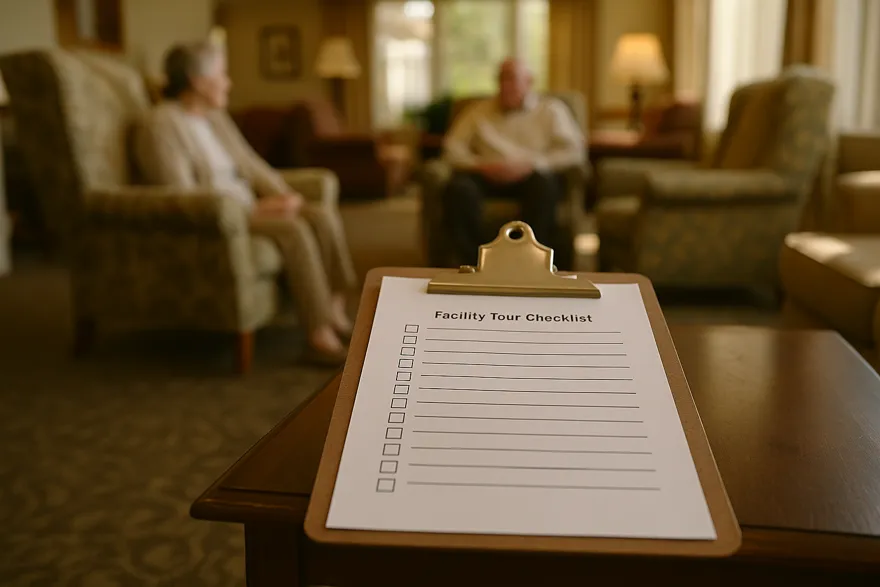
Before any tour
Every state licenses or certifies senior care facilities and publishes inspection results - Wisconsin's agency is listed below. Before any deposit near Twin Lakes, run every finalist through the state's records: complaint history, violations, and how the operator responded tell you more than any tour.
This guide is research, not advice: an independent summary of published costs and state rules. It is not a care provider, placement agency, law firm or financial advisor - care and Medicaid decisions deserve professional advice for your family's situation.
Common questions
Should my parent stay home with help or move to assisted living?
Run the hours math first: in-home care at about $35 an hour serves people who need help, not round-the-clock supervision. Below about 30-40 hours a week, home usually costs less; past that - or when safety needs someone always present - assisted living's $6,200 median often buys more coverage. The right answer follows the care needs, not the buildings.
How do I check a facility's inspection record?
Every state has a licensing or certification agency that publishes inspection results and complaint histories - this guide links your state's agency on every page. Search every finalist before any deposit: violations, complaint patterns and how the operator responded tell you more than the tour.
How much does in-home care cost?
About $35 an hour at the 2025 national median - roughly $80,000 a year at 44 hours a week. Since the 2025 survey, non-medical caregivers are tracked as a single category, so quotes for 'homemaker' versus 'home health aide' services should no longer differ much for non-medical help.
When should we start looking?
Before the crisis. Good communities near you have waitlists, and emergency placements take whatever bed is open at premium rates. Touring while your parent is stable costs nothing, builds the shortlist, and turns a future emergency into a phone call.
Does long-term care insurance actually help?
If your parent bought a policy years ago, yes - claim it early, as most policies have elimination periods before benefits start. Buying new coverage in one's 80s is generally not realistic. Check old files: policies bought decades ago are routinely forgotten and unclaimed.
What is memory care and why does it cost more?
Memory care is assisted living specialized for dementia - secured areas, higher staffing, trained caregivers - and typically prices 20-40% above standard assisted living in the same market. If dementia is in the picture, ask specifically about memory-care rates and staff training, not the general rate.
Compare senior care options near Twin Lakes
These platforms show communities and home-care agencies near you with pricing guidance. Advisors are free to families - providers pay them, as they do this site.
Disclosure: this is an independent guide. If you connect with a provider through a link here, the platform may pay this site a referral fee. That fee never changes your price - and it never changes what the inspection records say.
Prices in nearby cities
Two Rivers · Union Center · Union Grove · Unity · Valders · Vernon · Verona · Vesper · Viola · Viroqua · Waldo · Wales