The checks that protect your parent - most families never run them
Every Utah facility has a public inspection file. How Richfield families read it, the tour questions that matter, and the red flags that end a visit.
Assisted living near Richfield compares against a national median of $6,200 a month - and Utah's own median of $5,475, ranked #38 of 50 states.
Richfield plus 4 surrounding towns within 40 km share one senior-care market of about 17,492 people - comparing 3-4 communities is realistic.
A semi-private nursing home room runs $9,581 a month at the 2025 national median - the number Richfield families weighing skilled care start from.
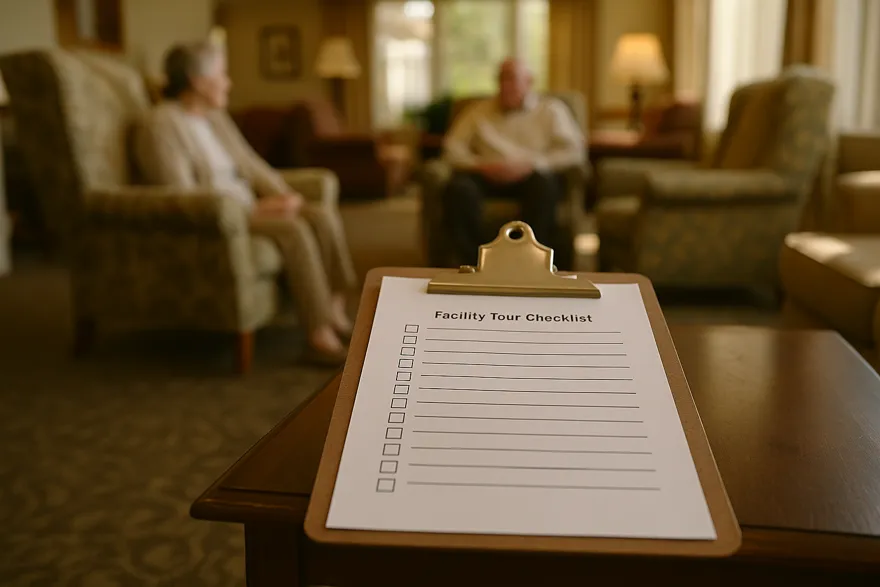
Every state licenses or certifies senior care facilities and publishes inspection results - Utah's agency is listed below. Before any deposit near Richfield, run every finalist through the state's records: complaint history, violations, and how the operator responded tell you more than any tour.
The tour shows you the lobby; the inspection file shows you the night shift. A community with a clean record and honest answers about staffing ratios is worth a premium over a cheaper one that dodges both questions.



The 2026 numbers
| Care type | 2025 national median | What it covers |
|---|---|---|
| In-home care | $35/hour | Non-medical help at home - meals, bathing, companionship |
| Adult day care | $95/day | Daytime supervision and activities, evenings at home |
| Assisted living | $6,200/month | Housing plus daily-living help; care-level fees extra |
| Memory care | typically 20-40% above assisted living | Secured dementia care with higher staffing |
| Nursing home (semi-private) | $9,581/month | 24/7 skilled medical care |
| Nursing home (private room) | $355/day | Same care, private room |
Find senior care options near Richfield
These platforms show communities and home-care agencies near you with pricing guidance. Advisors are free to families - providers pay them, as they do this site.
Disclosure: this is an independent guide. If you connect with a provider through a link here, the platform may pay this site a referral fee. That fee never changes your price - and it never changes what the inspection records say.
On the tour: what checks out - and what should end the visit
Good signs
- Staffing ratios for nights and weekends given plainly, in writing
- Administrator with years of tenure who knows residents by name
- Clean, current inspection file - and honest talk about past citations
- All-in pricing at your parent's assessed care level, itemized
- A straight, written answer to 'what happens when funds run out'
Walk away when you see
- Same-day discount pressure on a decision about your parent's life
- Ratio and turnover questions deflected with brochure language
- Base-rent quotes that get vague when care-level fees come up
- Unexplained citations in the state inspection file
- Midday common areas where residents sit unengaged and unattended
Verify before any deposit
- State license or certification current - check the agency linked on this page
- Inspection and complaint history for the last three years
- Staffing ratios in writing, including nights and weekends
- All fees itemized: base, care levels, medication management, move-in
- Discharge and eviction policy - the conditions under which they can ask your parent to leave
Utah: Medicaid, prices and the inspection file
| Question | Utah answer |
|---|---|
| Medicaid & assisted living | Yes - Utah Medicaid's New Choices Waiver (a 1915(c) HCBS waiver run by the Utah Dept. of Health and Human Services, Office of Long Term Services & Supports) covers 'adult residential services' and other supports for people who live in a licensed Type I or Type II assisted living facility, but like all HCBS waivers it does not pay room and board, which the participant pays from their own income. |
| State median, assisted living | $5,475/month (#38 of 50 states) |
| Licensing & inspection records | Utah Department of Health and Human Services, Division of Licensing and Background Checks (Office of Licensing) - health facility licensing |
Utah licenses two levels in statute: a 'type I' assisted living facility for residents who can exit the building without another person's help, and a 'type II' assisted living facility providing coordinated personal and health care services 24 hours a day in a home-like setting.
This guide is research, not advice: an independent summary of published costs and state rules. It is not a care provider, placement agency, law firm or financial advisor - care and Medicaid decisions deserve professional advice for your family's situation.

What this means for Richfield families
A fair comparison prices the whole picture: home care hours plus home maintenance, transport, and the family hours nobody bills. Communities bundle those in - which is why the sticker comparison understates what assisted living replaces.
This guide is research, not advice: an independent summary of published costs and state rules. It is not a care provider, placement agency, law firm or financial advisor - care and Medicaid decisions deserve professional advice for your family's situation.
Common questions
Should my parent stay home with help or move to assisted living?
Run the hours math first: in-home care at about $35 an hour serves people who need help, not round-the-clock supervision. Below about 30-40 hours a week, home usually costs less; past that - or when safety needs someone always present - assisted living's $6,200 median often buys more coverage. The right answer follows the care needs, not the buildings.
How much does in-home care cost?
About $35 an hour at the 2025 national median - roughly $80,000 a year at 44 hours a week. Since the 2025 survey, non-medical caregivers are tracked as a single category, so quotes for 'homemaker' versus 'home health aide' services should no longer differ much for non-medical help.
Does long-term care insurance actually help?
If your parent bought a policy years ago, yes - claim it early, as most policies have elimination periods before benefits start. Buying new coverage in one's 80s is generally not realistic. Check old files: policies bought decades ago are routinely forgotten and unclaimed.
What is the difference between assisted living and a nursing home?
Assisted living provides housing plus help with daily activities - meals, medication, bathing - at a median $6,200 a month. Nursing homes provide 24/7 skilled medical care at a median $9,581 a month for a semi-private room. The dividing line is medical need: wound care, feeding tubes and ventilators are nursing-home territory.
How much does assisted living cost?
The U.S. median is $6,200 a month ($74,400 a year) per the 2025 CareScout Cost of Care Survey - before care-level fees, which add hundreds more at higher need levels. State medians vary widely; this guide shows your state's number and rank on every page.
Find senior care options near Richfield
These platforms show communities and home-care agencies near you with pricing guidance. Advisors are free to families - providers pay them, as they do this site.
Disclosure: this is an independent guide. If you connect with a provider through a link here, the platform may pay this site a referral fee. That fee never changes your price - and it never changes what the inspection records say.
Prices in nearby cities
Richmond · River Heights · Riverdale · Riverton · Rockville · Rocky Ridge · Roosevelt · Roy · Rush Valley · Salem · Salina · Salt Lake City